
ACFM Inspection UAE | Offshore & Oil & Gas Weld Crack NDT
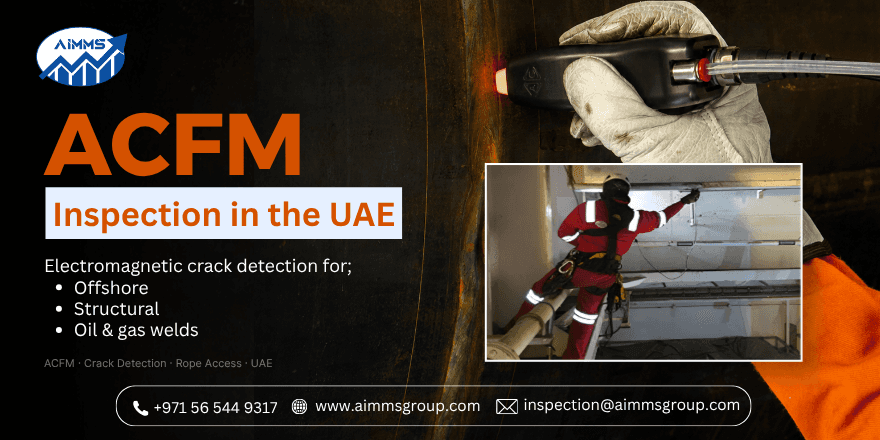
ACFM Inspection in UAE: Crack Detection for Oil & Gas & Offshore Welds
Cracks in welded structures can develop without obvious visual signs, particularly in offshore platforms, marine structures, pressure-containing equipment and other assets exposed to cyclic loading. When conventional inspection requires extensive surface preparation or coating removal, ACFM testing can provide an alternative approach for detecting and sizing surface-breaking cracks.
AIMMS Group provides advanced NDT inspection services in the UAE, including ACFM testing for applicable weld and structural inspection requirements.
The UAE’s oil, gas and offshore sector operates in a demanding environment. High humidity, saline exposure and constant cyclic loading can accelerate fatigue cracking at welds and structural connections. Identifying this type of cracking at an early stage can support more informed maintenance and repair planning, particularly for offshore platforms, subsea structures and other assets where access is difficult and unplanned downtime can be costly.
What Is ACFM Testing?
ACFM (Alternating Current Field Measurement)
ACFM (Alternating Current Field Measurement) is an advanced electromagnetic non-destructive testing (NDT) technique used to detect surface-breaking cracks in conductive materials. It detects disturbances in the electromagnetic field caused by cracks and discontinuities in the inspection surface. The technique can also provide information on the location, length, and depth of detected cracks.
How Does ACFM Inspection Work?
Probe introduces an alternating electromagnetic field.
The field interacts with conductive material.
A crack disturbs the induced current/field.
The instrument detects the disturbance.
The system helps identify and size the indication.
Inspection data can be recorded for reporting and review.
What Can ACFM Detect?
Surface-breaking cracks
Fatigue cracks
Weld toe cracks
Weld-related cracking
Cracks in structural components
Applicable defects in offshore structures
Surface-breaking defects in tanks and piping
ACFM is particularly established for detecting and sizing surface-breaking cracks in metallic welds and structures.
Where Is ACFM Testing Used?
Oil & Gas Facilities
Structural welds
Piping
Tanks
Process equipment
Offshore structures
Offshore Platforms
Welded structural connections
Fatigue-sensitive areas
Hard-to-access welds
Marine & Subsea Structures
Vessel structures
Offshore structures
Subsea weld inspection where applicable
Rope Access Inspection
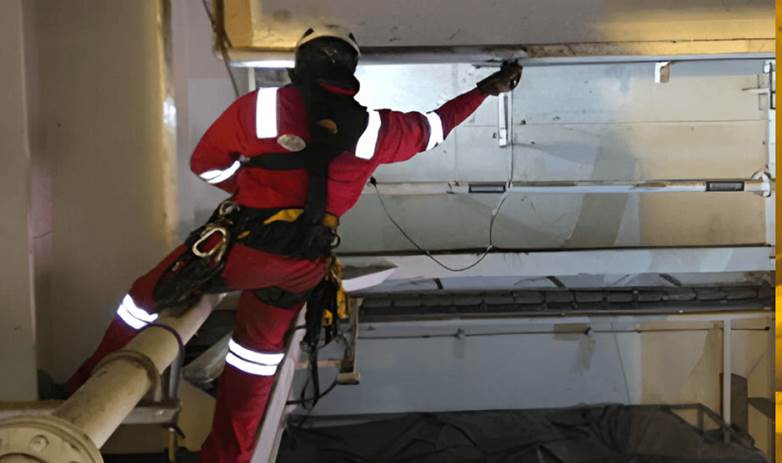
Where scaffolding or conventional access is impractical, ACFM inspection can be carried out by qualified personnel using rope access techniques. This allows suitable inspection of offshore platform structures, elevated or hard-to-reach welds, flare structures and towers, and other confined or restricted-access areas that are unsuitable for scaffolding or man-lifts. Since ACFM equipment is portable and does not require extensive surface preparation, it is well suited to being deployed by rope access technicians in these elevated or confined locations.
Why Use ACFM for Offshore & Oil & Gas Inspection?
Less surface preparation
Suitable ACFM applications can reduce the need for extensive coating removal.
Crack sizing
ACFM can provide information on both crack length and depth.
Difficult access
ACFM can be deployed in challenging locations, including offshore environments and certain subsea applications.
Inspection records
Digital inspection data can support reporting and later review.
Reduced disruption
Where the application is appropriate, reducing preparation requirements can help improve inspection efficiency.
ACFM Testing for Weld Inspection
Weld toes
Fillet welds
Structural welds
Fatigue-sensitive weld locations
Offshore welded structures
Crack detection and sizing
ACFM was developed around the challenge of detecting fatigue cracking in welded offshore structures, and it remains strongly associated with offshore weld inspection.
When Should You Consider ACFM Instead of Conventional NDT?
When surface-breaking cracking is the primary concern
When the inspection area is difficult to access
When extensive coating removal is undesirable
When crack sizing is required
When inspecting applicable offshore or marine structures
When a digital inspection record is beneficial
The appropriate NDT method should always be selected based on the material, component geometry, suspected defect type, surface condition, accessibility and applicable inspection requirements.
Industry Standards & Compliance
ACFM inspections for UAE oil & gas and offshore projects are typically carried out with reference to recognised international codes and client-specific integrity procedures. Depending on the project, this can include standards and guidance such as:
API RP 2X
DNV-RP-B101
Relevant ASME and ISO NDT codes
Client and project-specific inspection procedures
AIMMS Group inspection personnel typically hold relevant NDT certifications, such as PCN or ASNT qualifications, appropriate to the technique and application.
Frequently Asked Questions:
1. Can ACFM inspection be performed without removing protective coatings?
In suitable applications, ACFM can inspect through certain non-conductive coatings, which may reduce the need for extensive coating removal. The suitability depends on factors such as coating type, thickness, surface condition and the inspection requirement.
2. How long does an ACFM inspection take?
The inspection time depends on the size and condition of the inspection area, number of welds, accessibility and inspection scope. ACFM can be efficient for suitable applications because it may reduce the surface preparation required before inspection.
3. Can ACFM inspection be performed using rope access?
Yes, where the inspection location and conditions are suitable, ACFM equipment can be used by qualified personnel working with rope access techniques. This can help inspect welds and structural areas that are difficult to reach using conventional access methods.
4. What information is provided in an ACFM inspection report?
An ACFM inspection report can document the inspected areas, identified indications, relevant crack measurements and inspection results. The exact reporting details depend on the inspection procedure, client requirements and applicable standards.
5. What is the difference between ACFM and eddy current testing?
Both are electromagnetic NDT techniques, but they are typically used for different purposes. Eddy current testing is commonly used for near-surface flaw detection, corrosion mapping and conductivity checks, while ACFM is particularly associated with detecting and sizing surface-breaking cracks in welds and structural components. The appropriate technique depends on the suspected defect type and inspection objective. ACFM is more suitable for job with thick coatings comparing to Eddy current testing method.
6. Does an ACFM inspection require operations to be shut down?
In many cases, ACFM inspection can be planned around ongoing operations, particularly where access can be arranged safely without interrupting the wider process. Whether a full or partial shutdown is required depends on the location, applicable safety requirements and inspection scope, and this is typically agreed with the client before mobilization.
ACFM Testing Services in UAE
AIMMS Group provides advanced NDT inspection services for oil & gas, marine and industrial applications in the UAE. Our inspection capabilities include ACFM for applicable crack detection and sizing requirements, supported by experienced NDT personnel and complementary inspection techniques.
ACFM
Eddy Current Testing
UT/UTG
MPI
DPI
Visual Inspection
Rope Access
Marine inspection
Asset integrity inspection
Crane Inspection
Offshore platform structural welds
Need ACFM Inspection for a Weld, Offshore Structure or Industrial Asset?
If you need to investigate suspected surface-breaking cracks, fatigue cracking or weld indications in a difficult-to-access area, AIMMS Group can review your inspection requirement and advise on the appropriate NDT approach.
Contact AIMMS Group to discuss your ACFM inspection requirements in the UAE.
inspection@aimmsgroup.com
www.aimmsgroup.com


AIMMS Group is a UAE based Marine inspection, maintenance and rope access services provider having delivery centers in India, KSA & UK. Our NDT & UT Gauging team is well versed with oil, gas & marine industries and have delivered services to leading organizations in the sector across the waters. Our rope access based mechanical team is well equipped & skilled to meet corrosion protection, welding , fabrication, painting requirements of any industries.
FOLLOW US
Connect for real-time updates and expert perspectives on industry trends.
HEADQUARTERS
M-35- 16th St, Building 3,
Musaffah,B-2- 18, ICAD, Abu Dhabi, UAE.
PHONE
SERVICES
Copyright © 2024 AIMMS Group. All Rights Reserved.