
Holiday Inspection: Pinhole Detection & Coating Testing | UAE
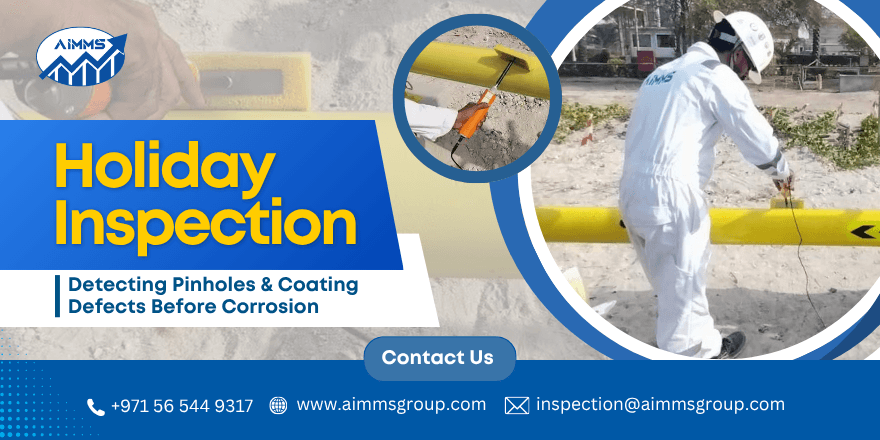
Holiday Inspection: Detecting Pinholes & Coating Defects Before Corrosion
Coating failures almost never start where you can see them. A pipeline, a tank, an offshore structure, all get coated to keep corrosion out for decades, and the coating usually looks fine right up until it isn't. The actual failure point is often a pinhole you'd need a magnifying glass to spot, sitting there quietly letting moisture and oxygen through to bare steel. Holiday Inspection exists to catch that before the asset is commissioned, not after years into service when the damage is already done.
At AIMMS Group, this is a routine part of our NDT work, usually done alongside other coating and integrity checks on the same site visit, for oil & gas, marine, and industrial clients across the UAE and further afield.
What Counts as a Holiday in Coating Inspection?
A "holiday" is any break in a coating's continuity, a pinhole, a void, a thin patch, a hairline crack. Most of them come down to something ordinary going wrong during application: a trapped air bubble, dust or oil on the surface before coating, a sharp edge the film couldn't wrap properly, or the applicator simply running thin in one spot without anyone noticing at the time.
Why Holiday Testing Matters
It's a fair question, especially on a tight schedule: why add a test for something that might not even be there? A few honest reasons this keeps showing up in coating specifications:
● It's cheap insurance. Fixing a holiday before commissioning takes minutes. Fixing the corrosion it caused two years later can mean cutting into a pipeline.
● Coatings are asked to last decades. A single missed pinhole can undercut that entire design life, especially in humid or offshore conditions where moisture is never in short supply.
● It's often contractual, not optional. Many project specs require a documented holiday test before a coating is accepted and handed over.
● It's the proof, not just the process. A signed holiday test report is what a client or auditor actually looks at later to confirm the work was done properly.
How Holiday Testing Works
An intact coating acts as an insulator. The steel underneath is a conductor. Run a voltage across the surface with a brush, sponge, or wand, and if the coating is doing its job, the current has nowhere to go.
If there's a gap, though, the current finds its way through to the substrate, completes a circuit, and sets off the detector's alarm right at that point, usually a beep, a light, or a visible spark depending on the equipment. The inspector marks it, it gets repaired, and that patch gets tested again before anyone signs off.
Holiday Testing Methods
Low Voltage (Wet Sponge Method)
This is the gentler of the two, used on thinner coatings, roughly up to 500 microns (20 mils). A sponge soaked in water and a wetting agent is passed over the surface. Because the voltage is low, it won't damage thin-film coatings the way a higher voltage might, which also means it's less prone to throwing false positives on delicate finishes.
High Voltage (Spark Testing Method)
For thicker coatings and pipeline wraps, generally above 500 microns and up to about 25mm, a DC or pulsed DC probe applies a voltage calculated from the coating's thickness (standards like ASTM D5162 and NACE SP0188 lay out how to work that out). It handles messier real-world conditions better too, damp, dirty, or slightly conductive surfaces don't throw it off the way they would a low voltage test. The trade-off is that getting the voltage wrong matters more here: too low and you miss defects, too high and you can damage the coating you're supposed to be checking.
Holiday Testing Equipment: Elcometer 270
For wet sponge work, we use the Elcometer 270 Pinhole Detector, a fairly standard piece of kit in this line of work. It covers coatings up to 500 microns, offers a few voltage settings depending on the model (9V, 67.5V, 90V), and has a built-in test/check function, which matters more than it sounds like it should. Calibration drift is a real thing on a busy site, and being able to confirm the unit is reading correctly before every single use, not just once a week, is what actually keeps results trustworthy.
Holiday Testing Standards
None of this is done on a whim. Test voltage, method selection, and pass/fail criteria all come from established standards:
● NACE SP0188 / RP0188, Discontinuity (Holiday) Testing of New Protective Coatings
● ASTM D5162, Holiday Testing of Nonconductive Coatings on Metallic Substrates
● ASTM G62, Holiday Detection in Pipeline Coatings
● ISO 29601 / ISO 8289, Holiday detection of coatings
Following these is what makes a test result mean something to someone who wasn't on site, a client, an auditor, a regulator reviewing the paperwork years later.
How to Read Holiday Test Results
The test itself gives a simple pass or fail, but what goes into the report is where the real value sits:
● The alarm confirms it. A tone, an LED, or a spark marks the exact point of a holiday, no guesswork involved.
● Everything gets marked on the spot. Not logged from memory later, marked immediately, before the inspector moves to the next section.
● Repairs get retested, always. A fix isn't considered done until that patch passes on its own.
● The report carries the detail. Voltage used, equipment calibration status, area covered, what was found, what was repaired.
● A pass means zero holidays. Across the full area, at the right voltage, with equipment that's actually calibrated. Nothing less counts.
Where Holiday Inspection Is Used
● Oil and gas pipelines, both above-ground and buried
● Storage tanks and pressure vessels
● Offshore structures and marine assets
● Water and wastewater infrastructure
● Structural steel and industrial plant equipment
● Tank linings and secondary containment systems
● Pre-fabricated pipe coatings, tested before they're even installed
Holiday Testing Checklist
● Coating is fully cured, not just dry to the touch
● Method chosen (wet sponge vs. high voltage) actually matches the coating thickness
● Test voltage calculated and set correctly
● Detector calibration checked before starting, every time
● Earth/ground connection confirmed where the method requires it
● Entire surface scanned, no sections skipped to save time
● Every holiday found is marked clearly
● All repaired areas retested before sign-off
● Results recorded in a formal report
● Calibration certificate for the equipment is still current
Other Inspection Work We Do
Holiday Testing is one piece of a bigger inspection scope. AIMMS Group also handles:
● Non-Destructive Testing (NDT)
Why Clients Choose AIMMS Group
Operators in marine, offshore, industrial, and oil & gas work don't have much patience for inspection partners who are slow, inconsistent, or hard to reach mid-project. That's really the bar we work to, whether it's a routine job in the UAE or a project further out. In practice that means:
● Qualified, experienced NDT inspectors, not generalists filling a gap
● Portable UCI hardness testing equipment for accurate on-site readings
● Fast mobilization, including for jobs outside the UAE
● Digital reporting clients can actually find later, not paper buried in a folder
● Dedicated coverage for shutdowns and turnarounds, when timing is everything
● Independent, third-party inspection clients can point to with confidence
● Real depth in marine and offshore environments specifically
More on our Third-Party Inspection Services and Marine NDT Inspection Services if you want the fuller picture.
Frequently Asked Questions
Does holiday testing damage the coating?
Not when it's done correctly. It's classed as non-destructive testing precisely because, at the right voltage, it doesn't harm an intact coating.
How do you know what voltage to use?
It's calculated from coating thickness, based on the manufacturer's data sheet or the applicable standard (ASTM D5162 and NACE SP0188 are the usual references).
Can you test on a damp or dirty surface?
With a high voltage detector, generally yes. That tolerance is one reason it's preferred for site conditions that a low voltage wet sponge test would struggle with, including humid coastal environments like the UAE.
What happens once a holiday is found?
It gets marked, repaired to spec, and retested. Nothing is signed off until that retest passes.
How often does the equipment need calibrating?
Checked before every use via the built-in test function, and formally calibrated at whatever interval the manufacturer or standard specifies.
Is holiday testing always required?
No. It depends on the project spec, the coating system, the service environment, and the standard the job is being built against.
Who actually provides this service?
AIMMS Group runs Holiday Inspection as part of our broader NDT and coating inspection work, for clients across the UAE and on international marine, offshore, and industrial projects.
Conclusion
Holiday Inspection doesn't take long, and most of the time it doesn't even find anything. But that's exactly the point. It's a small check that closes a real gap between a coating that looks finished and one that actually is, and it's a lot cheaper to run than the alternative of finding out the hard way.
At AIMMS Group, we build it into our wider NDT and coating inspection work so clients across the UAE and internationally have an actual record, not just an assumption, that the protection on their asset is doing what it's supposed to.
Get in touch with AIMMS Group to talk through your Holiday Inspection and coating testing requirements.


AIMMS Group is a UAE based Marine inspection, maintenance and rope access services provider having delivery centers in India, KSA & UK. Our NDT & UT Gauging team is well versed with oil, gas & marine industries and have delivered services to leading organizations in the sector across the waters. Our rope access based mechanical team is well equipped & skilled to meet corrosion protection, welding , fabrication, painting requirements of any industries.
FOLLOW US
Connect for real-time updates and expert perspectives on industry trends.
HEADQUARTERS
M-35- 16th St, Building 3,
Musaffah,B-2- 18, ICAD, Abu Dhabi, UAE.
PHONE
SERVICES
Copyright © 2024 AIMMS Group. All Rights Reserved.